
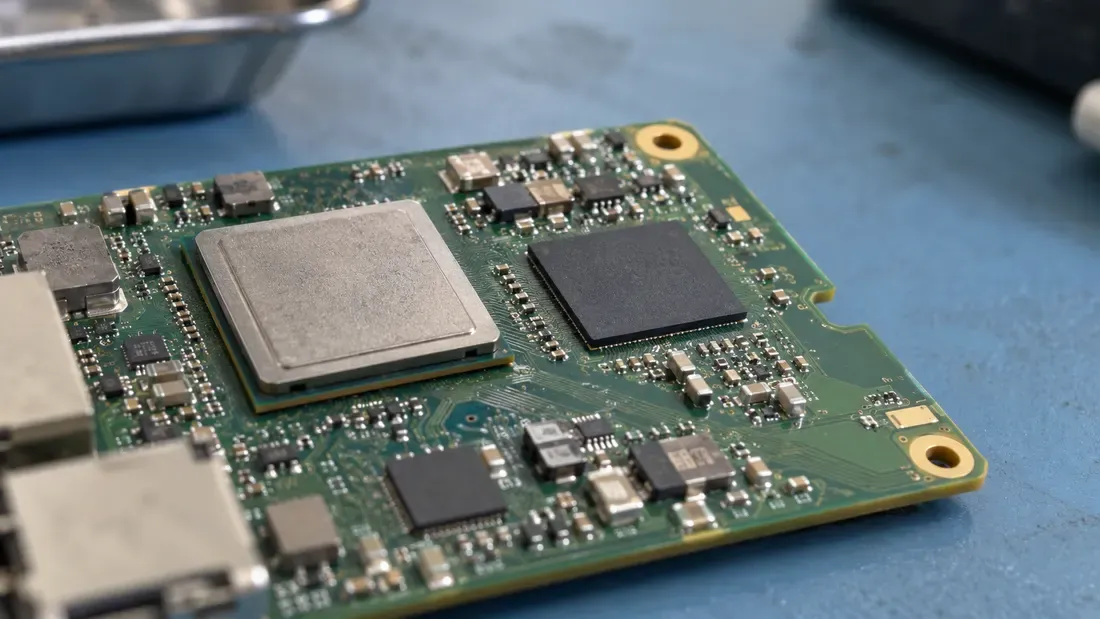
What Is eMMC Storage? How It Works and Where It Fits
- eMMC combines NAND flash and a controller behind a standard block interface in a board-level package.
- The host, board and exact device determine boot behavior, supported modes and replacement options.
- A capacity label, package shape or eMMC revision alone cannot establish usable space, endurance or compatibility.
- Confirm bus mode, clock, voltage, NAND type, temperature grade and power-loss behavior for the exact part and host.
eMMC storage is NAND flash and a controller in one board-level package, presented to an embedded host through a standardized interface. The controller manages low-level flash tasks such as bad-block handling, error correction and wear management. The host sees a block storage device, but it still has to support the interface and manage its own boot, filesystem and application behavior.
The name stands for embedded MultiMediaCard. In an equipment design, “embedded” describes how this component is integrated; it does not mean that every embedded storage device is eMMC. The SD Association's Embedded SD standard is a separate example. Nor does a BGA package by itself identify eMMC: BGA describes the connections underneath a chip, not the storage protocol.
What is inside an eMMC package?
NAND stores data; the controller translates host block requests into flash operations and handles physical management that raw NAND would otherwise require elsewhere in the system. The eMMC interface and feature set are specified within JEDEC's embedded flash standards. An exact product's NAND type, firmware, capacity and supported functions still vary by part number.
This integration can reduce the host's low-level flash-management work. It does not make storage performance or data integrity independent of the system. Workload, power behavior, software, filesystem, temperature and the device's internal design all matter. A successful boot on one sample is not proof of endurance or compatibility across a production lot.
eMMC is usually soldered to the PCB. A microSD card is removable and uses a different standards family. UFS is also commonly board-level managed flash, but uses a different interface. Those distinctions affect the SoC controller and board design; a matching capacity or package outline is not enough to swap one for another. See eMMC, UFS or microSD: interfaces and host compatibility for the fuller comparison.
What does a capacity such as 128GB mean?
A 128GB label describes nominal decimal gigabytes. Dividing 128,000,000,000 bytes by 1,073,741,824 bytes per binary gibibyte gives about 119.2GiB. That is a unit conversion using NIST's binary prefixes, not a measurement of a particular eMMC part. The device-reported user area and the space available after partitioning, formatting and stored files are separate figures. A host may also label a binary quantity “GB,” so compare bytes rather than display labels alone.
eMMC devices can expose user and dedicated boot areas. Which area a system boots from depends on its SoC, board and boot configuration. For example, AMD documents several eMMC boot arrangements for one SoC family; that implementation is not a universal recipe for every board. Ask for the exact device datasheet and host documentation before assuming partition sizes or features. Our capacity conversion explanation covers the units in more detail.
Where is eMMC used?
An equipment maker may use eMMC for a boot image, operating system, application data or local logs in a compact design. Industrial terminals, gateways, point-of-sale devices and set-top boxes are examples of systems that may use embedded storage; this is a list of possible roles, not a claim that a particular Kalstor part has been qualified in those devices.
The right choice depends on the device's read and write pattern. A mostly read-only system image and a continuously rewritten event log impose different demands. Also decide whether field replacement must be possible without board rework. eMMC's soldered integration changes that service decision; it does not eliminate system-level vibration or power-interruption checks.
What should a buyer check before selecting a part?
| Check | Why it matters |
|---|---|
| Interface revision | Confirm whether the exact part implements the required eMMC 5.0 or 5.1 features, and whether the SoC, board and software support that revision and boot path. A revision label alone does not establish that a feature is enabled. |
| Bus width, mode and clock | Record the supported and actually negotiated data-bus width in bits, such as x1, x4 or x8 where applicable, the host mode (for example HS200 or HS400), and the specified and observed clock in MHz. Check both device and host limits; interface bandwidth is not application throughput. |
| Transfer performance | Compare the exact part's read and write figures with their test conditions, including transfer size, queueing, cache state and temperature. Validate sustained and application-level behavior on the target board. |
| Supply and I/O voltage | Match the part-specific VCC and VCCQ ranges, power-up sequence and signal levels to the released schematic and host. Do not substitute one voltage figure for both rails. |
| NAND and endurance | Ask whether the proposed configuration uses MLC, TLC or another NAND type, then obtain its part-specific endurance and workload assumptions. NAND type alone does not establish service life. |
| Temperature grade | Record the exact commercial, industrial or automotive-rated operating range and the evidence for the proposed part. A grade name does not qualify the complete equipment. |
| Data protection | Confirm the controller's internal ECC and the exact part's documented behavior during sudden power loss. ECC corrects some media errors; it does not by itself protect in-flight writes. Do not assume power-loss protection or a zero-loss guarantee without device and system evidence. |
| Exact package | Confirm ball map and dimensions against the released board, not just the word “BGA.” |
| Capacity and configuration | Compare reported user capacity, boot-area needs and any required security or management functions for the exact part. |
| Supply identity | Record the complete ordering code, revision and change-control requirements; a family name alone cannot lock a production BOM. |
Vendor selection fields illustrate why these checks belong to an exact ordering code: Micron lists protocol revision, NAND technology, voltage and temperature separately. Its eMMC FAQ distinguishes internal ECC from a configurable static-data power-loss feature on particular devices. Neither vendor example establishes the specification or protection behavior of a Kalstor candidate; obtain that candidate's datasheet and test the complete host power path.
For an existing board, part substitution needs more than this first-pass list. The eMMC/UFS second-source qualification guide covers system validation and change control.
Kalstor's eMMC hardware range
Kalstor's embedded BGA product page lists a configurable eMMC 5.1 portfolio from 4GB to 128GB. Capacity, NAND option, temperature grade, package and performance must be confirmed for the exact candidate; the page does not promise every combination. Kalstor supplies storage hardware. The equipment maker or its appointed provider remains responsible for host integration, software images and system qualification.
For a hardware inquiry, send the SoC and board model, current part number if replacing one, required capacity, package, workload, environment and expected quantity through the quote form. That information allows a candidate to be discussed without treating “eMMC 5.1” as a complete purchase specification.
FAQ
Is eMMC the same as a microSD card?
Does 128GB eMMC provide exactly 119GB of free space?
References
- JEDEC — flash storage standards focus area ↩
- Samsung Semiconductor — eMMC-to-UFS architecture explanation ↩
- SD Association — Embedded SD standard overview ↩
- AMD — eMMC v5.1 boot mode in one SoC family ↩
- NIST — binary prefixes ↩
- Micron — eMMC part cross-reference and selection fields ↩
- Micron — managed-flash ECC and power-loss feature boundaries ↩
We publish measured usable capacity and define trial-batch verification against the quoted product and agreed test scope.