
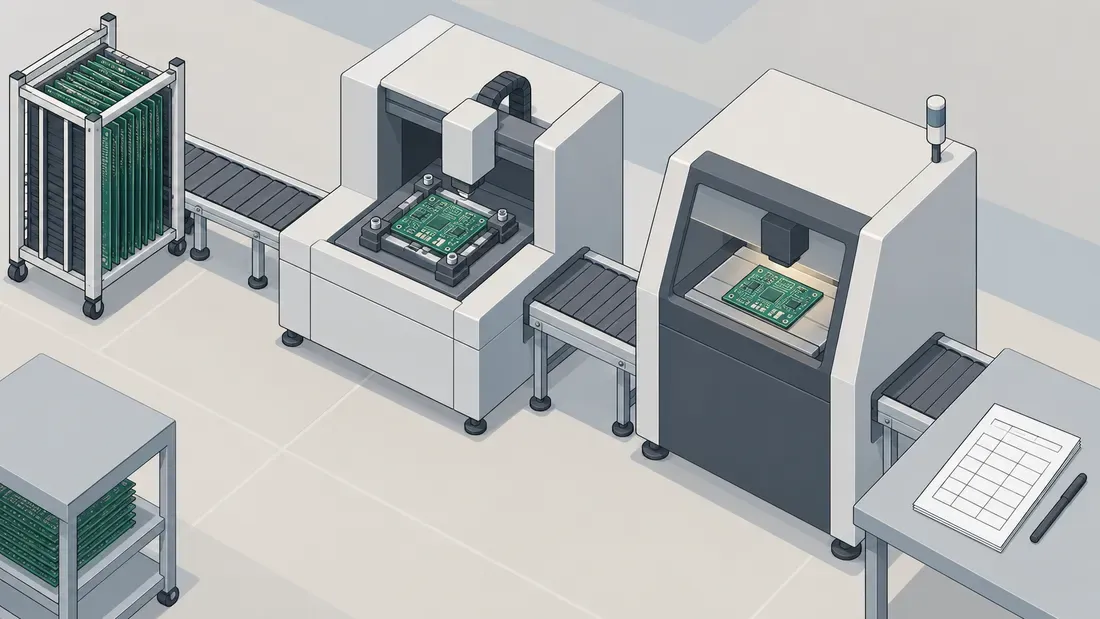
Measuring eMMC Programming Stage Times at Production Stations
- Log flashing, verification, personalization, and boot testing stages as discrete time intervals.
- Avoid summing sequential stage times naively when automated handlers or gang programmers overlap operations.
- Compute observed accepted units per station hour over a defined window including handling and rework.
A production station can report a fast eMMC write while completed good units leave the line slowly. To identify the bottleneck, time each stage and each unit instead of recording only an average “programming time.” The flow belongs to the buyer's factory or programmer; it is not a claim that Kalstor runs that station.
Define the stages before timing
| Stage | Start/end event to agree | Record beside elapsed time |
|---|---|---|
| Setup and handling | Unit/socket loaded to ready | Station, socket, part and image revision |
| Image transfer and write | Start transfer to device write complete | Image bytes, target region and tool result |
| Verification | Start approved check to pass/fail | Readback/hash method, scope and mismatch |
| Personalization, if required | Start unit-specific data step to confirmation | Data type and record ID, without exposing secrets |
| Functional boot | Power-on to defined application checkpoint | Board/BSP revision and result |
| Retry/rework | First fail to accepted disposition | Reason, extra cycles and final result |
A SEGGER production-programming example separates image preparation from writing. Micron's factory-programming notes apply to identified part families. Neither gives a universal Kalstor cycle time or verification method. Do not add permanent eMMC configuration or RPMB key steps to a timing script without the approved provisioning plan.
Calculate the output rate that purchasing needs
For a measured window, good units per hour = accepted completed units ÷ elapsed station hours. Include loading, verification, failures and rework in that window. Keep per-stage distributions to locate the delay. Parallel sockets or overlapped handling mean the sum of one unit's stage durations is not automatically the line takt. Report both the method and the actual observation window, then send part, image and verification requirements in a quote request.
References
We publish measured usable capacity and define trial-batch verification against the quoted product and agreed test scope.