
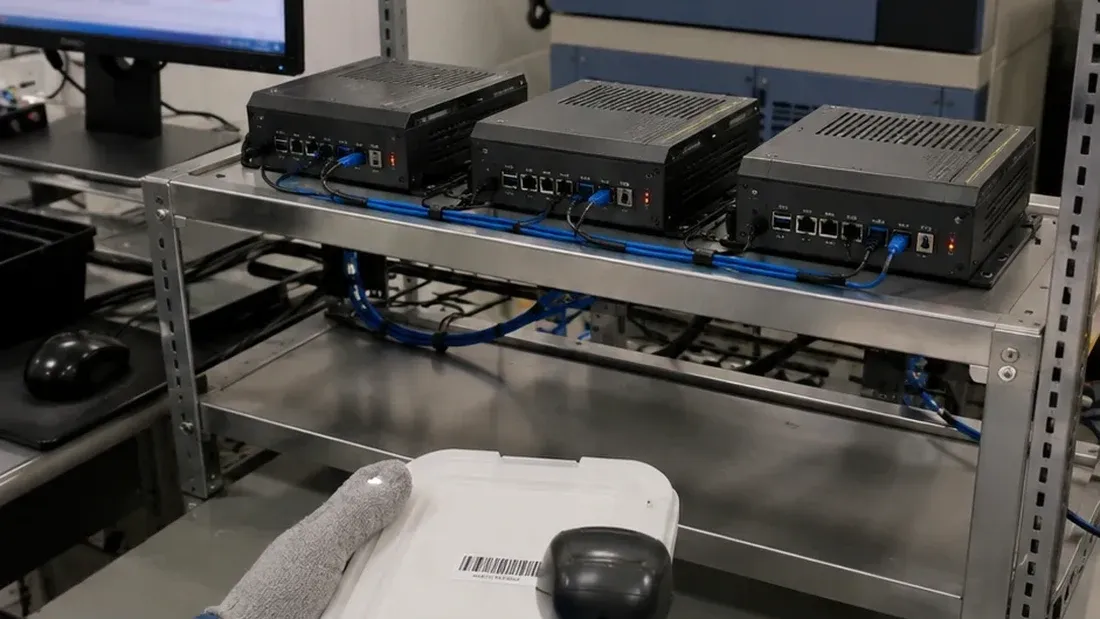
Edge AI storage validation: model loading is not production approval
- A successful load is one observation, not evidence of whole-system reliability.
- Test supported OTA resume and automatic recovery separately from interrupted installation and damaged hardware.
- Define data-loss boundaries and distinguish technical acceptance, commercial approval and lot release.
Loading a model successfully proves only that a particular read path completed at that time. Production approval also requires stable startup, file integrity, concurrent workload performance, near-full behavior, update recovery and traceable production configuration.
Image disclosure: the cover is an AI-generated process illustration, not evidence of laboratory capability, certification or an actual passing test.
How is a reproducible baseline established?
Record device and board revision, SoC, BIOS or bootloader, OS, drivers, application, model version, commercial storage SKU, readable identity, agreed controller/NAND/firmware configuration, capacity, partitions and format. Changes to any item can alter behavior. A pass without a baseline cannot support later incoming inspection or RMA analysis.
Before testing, define sample count, preconditioning, workload, observations, pass/fail limits and permitted interventions. The plan must distinguish the system-level symptom from a demonstrated storage root cause.
What should startup testing measure?
Separate power-on after an unpowered interval, software reboot, watchdog reset and abnormal recovery. A cold boot here means startup after power-off, not a low-temperature test. Temperature exposure needs its own ambient, dwell and equipment-state records.
Measure time to storage enumeration, filesystem availability, model verification and usable service. Preserve the failed stage. NVIDIA's partition documentation distinguishes boot components and storage locations [1]; placing the root filesystem on NVMe does not mean every boot component resides there.
How should model integrity be checked?
Record model hash, version, size, read errors, retries, memory-mapping behavior and an inference self-check. Obtain the expected hash from an independently retained trusted release, not from the suspect file after failure.
Distinguish first reads from cache hits. Hashing first can warm the file cache, and creating a memory mapping does not mean every page has been read. Decompression, deserialization and accelerator transfer can also contribute to load time. Report storage-read behavior separately from end-to-end service readiness.
Why include concurrent writes?
A device may load models while recording video, buffering sensors, updating a database and writing logs. Reproduce channel count, bitrate, file size, sync frequency and event peaks. Capture throughput, tail latency, timeouts, device disappearance, read-only transitions, missing files and application restarts.
Sequential speed in isolation does not represent this workload. A failure should retain synchronized application, OS and device observations wherever available.
What matters near full capacity?
Use several occupancy levels and record prior writes, preconditioning and supported discard/TRIM execution. Check write latency, log rotation, database maintenance, OTA reserve and alerts. Without internal telemetry, report observed delays rather than claiming a particular garbage-collection state.
Preserve a recovery path so root-partition exhaustion does not prevent diagnosis. Results apply to the tested filesystem, reserve and configuration, not every nominally similar device.
How should OTA, resumable downloads and automatic recovery be tested?
Cover supported full and differential updates, download interruption, verification failure, interrupted installation, first-boot failure and rollback. Android Virtual A/B illustrates snapshot-based updates and subsequent merging [2]; other systems require their own bootloader, partition and signature model.
Resumable download: interrupt network access, cause timeouts and restart at different progress points. Verify recognition of valid downloaded data, correct continuation offset and full integrity and signature checks before installation. If the server package changes, reject mixed versions and follow the designed restart behavior. Download resumption does not establish that arbitrary interrupted flashing can continue safely.
Automatic recovery: for mechanisms the device actually supports, inject controlled package corruption, invalid update state or first-boot failure. Check detection, re-download, bounded retry, switching to a valid system or rollback as designed. Record recovery time, retry limit, logs, retained user data and the alert or manual path when recovery is impossible. Recheck version, integrity and core functions afterwards.
Unsupported capabilities must be marked not applicable, not advertised as existing features. Software recovery cannot repair physically damaged storage. Use dedicated samples and backed-up test data for fault injection.
What should be checked after sudden power loss?
Do not interrupt production equipment or unique important files. On dedicated samples, record the interruption point, voltage fall and restoration, off-time, workload phase, cycle count and any backup power. Cover idle, reading, logging, recording, model update and OTA states. Add internal housekeeping states only if reliable telemetry identifies them.
After restoration, check enumeration, boot, filesystem, historical files, files being written, models and error logs. A closed file is not automatically durable: Linux close does not guarantee persistence, and synchronization and directory-entry handling need explicit consideration [4][5]. Record fsync/fdatasync results and cache-flush policy. Successful calls alone do not justify zero-loss claims under every system fault.
Define the allowed loss window, protected data, recovery deadline and failures needing intervention. Micron discusses particular eMMC power-loss configurations [3]; these are not a guarantee for every eMMC or for in-flight data. Confirm current part-specific documentation.
How should environment and long operation be combined?
Define temperature, ramp rate, vibration spectrum, axes, mounting and duration from the customer's equipment specification. Overlay realistic I/O with enough observability to diagnose failures. Do not combine all stresses into one opaque test and then assign every error to the storage.
Synchronize logs with power and environmental records. Preserve differences between enclosure conditions and component measurements and identify test limitations.
How do samples connect to lot release?
Retain sample IDs, raw records, configuration lists, lot identity, reference samples and actual approvers. Incoming production checks should verify identity and authenticity plus risk-based functional and performance sampling. Controller, NAND, firmware, PCB/package, production-site or test-process changes require review under the agreed PCN rules.
Technical acceptance means the sample met written test conditions. Commercial approval covers price, MOQ, delivery, payment, packaging, warranty, RMA and continuity. Production release additionally requires the real lot to match the approved baseline.
Send Kalstor the device, workload, interface, sample quantity, environment and acceptance criteria to define candidate configurations and an evidence matrix. Service scope must be confirmed in project documents; suggested tests are not claimed laboratory certifications. The AI camera storage guide shows how a workload budget feeds this validation plan.
FAQ
Does a week without errors justify production release?
Does recovery after power loss mean no data was lost?
References
We publish measured usable capacity and define trial-batch verification against the quoted product and agreed test scope.