
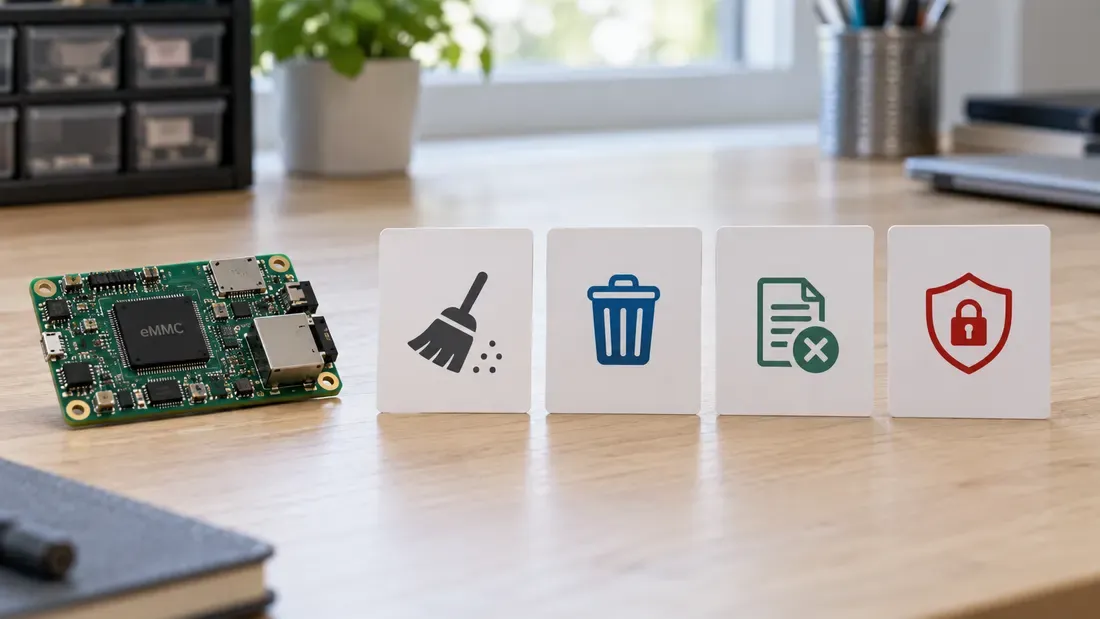
eMMC Erase, TRIM, Discard, and Sanitize: Technical Differences
- File deletion need not issue a discard; discard does not guarantee secure destruction.
- ERASE, TRIM and Sanitize are distinct device operations whose support and scope need part-specific confirmation.
- Kernel MMC attributes distinguish erase group size from TRIM granularity.
Deleting a file, sending a block discard and asking an eMMC device to sanitize are different actions. Which lower-level command follows a host request depends on the filesystem, driver and the exact device. None of these terms alone is proof that sensitive data has become unrecoverable.
Match the term to its layer
| Term | Layer and purpose | What it does not prove |
|---|---|---|
| File deletion | Filesystem removes a name and updates allocation metadata | Old contents were physically erased |
| Discard | Host block-layer request that ranges are no longer needed | A particular eMMC command was sent or data was securely destroyed |
| eMMC ERASE / TRIM | Device operations on specified address ranges when supported | Every obsolete copy in physical NAND was removed immediately |
| eMMC Sanitize | A distinct device operation available only when supported by the card and host path | A buyer's complete erasure policy or audit requirement has been met |
The Linux MMC attributes documentation distinguishes an eMMC erase_size field from TRIM's minimum unit. The MMC tools documentation lists a Sanitize command. These documents establish that the operations exist; they do not prove a particular Kalstor part, firmware or deployed host executes them. NVMe Sanitize is a separate protocol operation and must not be substituted for eMMC behavior.
Decide which evidence the project needs
For performance or space reclamation, record the exact device capability, filesystem mount policy, driver support and observed command path. For disposal or sensitive-data handling, begin with a defined threat model and approved erasure policy. Obtain the device-specific documentation for supported commands, scope and completion reporting; test the procedure on the target host and keep the result record. Do not infer secure erasure from fstrim, a deleted file or a generic benchmark. For component selection, send the required data-lifecycle behavior with a quote request.
We publish measured usable capacity and define trial-batch verification against the quoted product and agreed test scope.