
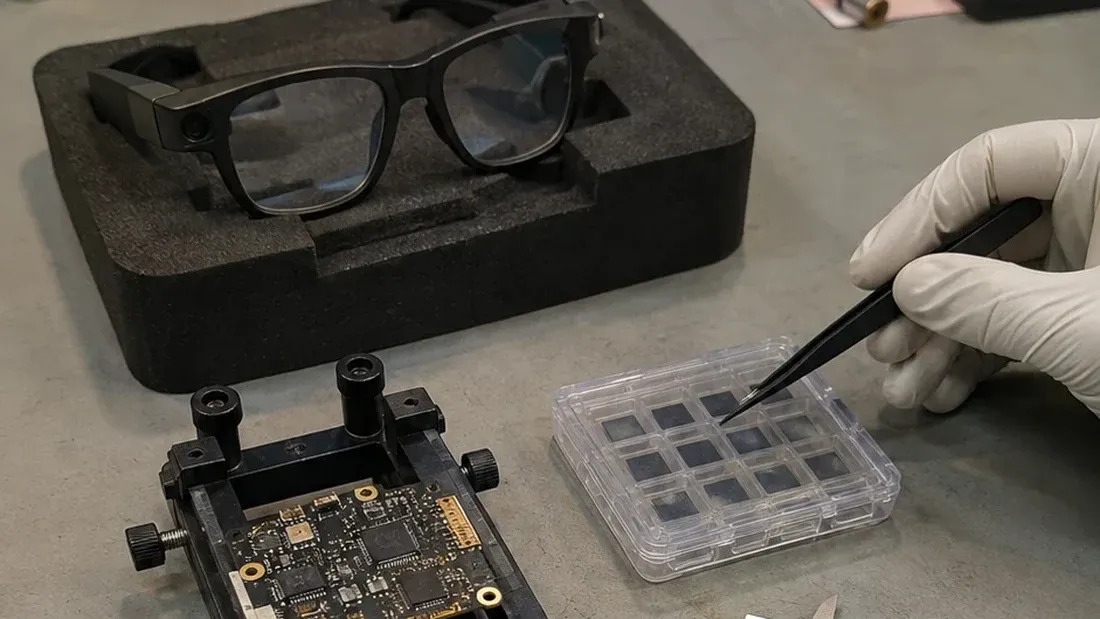
AI glasses and wearables: eMMC or UFS beyond capacity
- Separate on-device storage from data and models kept on a phone or server.
- UFS is not a drop-in eMMC replacement; validate host, package, power and software.
- Measure whole-device energy and latency across workloads instead of comparing one headline figure.
Do not replace eMMC with UFS merely to accelerate model loading. UFS requires compatible SoC interfaces, power, clocks, PCB routing and software. eMMC may remain appropriate for lighter workloads or constrained design budgets. Compare exact parts for package, power, temperature and lifecycle.
Image disclosure: the cover is AI-generated. The large board is not identified as an internal glasses PCB, and sample identities and handling actions are not verified. It is not an ESD procedure, design proof or customer-project photograph.
What must the wearable itself store?
First distinguish standalone devices from products relying on a phone or cloud service. Glasses may retain only firmware, settings and temporary buffers; full models or applications may reside on the phone. Do not charge every system-level file to the glasses' capacity.
For locally stored data, separate the OS, models, photos, audio, sensor records, logs and updates. Loading a model can create read peaks, while photos and audio create bursts and logging creates repeated small writes. Define retention and update overlap for each type.
Why do power and temperature matter more in a small enclosure?
A wearable has limited battery capacity and heat-spreading area and may contact the body. Storage activity overlaps with the SoC, camera, radio and display. Measure whole-device current and surface temperature during idle, model loading, recording, synchronization and updates.
A datasheet's low-power label is not a battery-life result. Include sleep entry, wake latency, task duration and realistic duty cycle. A faster transfer may shorten active time, but higher peaks and host behavior can change the overall result. The product's thermal acceptance limits must come from its design and applicable requirements.
How do eMMC and UFS differ?
Both are NAND-based managed storage. Micron describes integrated managed-NAND products, while KIOXIA explains UFS's serial interface compared with eMMC's parallel, half-duplex architecture [1][2]. Those differences do not establish that any UFS part outperforms or consumes less energy than any eMMC part in every device.
Protocol version, lanes, capacity, NAND, controller, firmware and drivers all matter. Confirm that the selected host supports the actual initialization and operating modes. A storage substitution can require a board and software redesign.
Why freeze the package early?
BGA length, width, height, ball count and ball map affect layout and assembly. Review keep-outs, stack-up, signal and power integrity, reflow conditions and moisture-sensitivity handling with the relevant component documentation. Micron's catalog illustrates part-specific package and lifecycle information [3], not a common specification for all suppliers.
A request for “128GB eMMC” is insufficient for a production BOM. Purchasing needs the full part number and revision plus the approved package drawing and electrical interface. Clarify whether a proposed alternate needs new routing or assembly validation.
What should near-full and write-life tests consider?
Filesystem free space is not the same as internal free blocks or reserved NAND. Supported discard/TRIM behavior, provisioning, prior writes and workload influence reclamation and latency. Research on SSD TRIM and write amplification helps explain these variables [5], but an SSD model is not a measurement of a candidate eMMC or UFS device.
Record daily host writes, file sizes, synchronization frequency, retention, occupancy, preconditioning and service-life target. Test the intended mix of audio, photo cache, logs and model updates. Measure latency, warning thresholds and recovery space without applying one universal free-space percentage.
How should OTA space be budgeted?
Download packages, candidate models, snapshots and rollback versions may coexist. Android Virtual A/B uses snapshots, with compression reducing some overhead where supported and enabled [4]. Temporary space is still necessary. Other operating systems need their own calculation from image sizes, partitions and recovery design.
Test the largest supported update while ordinary device activity continues. Clarify which user data must remain intact if the update fails and how a low-space condition is presented before installation.
How should lifecycle and alternate sourcing be controlled?
Confirm part status, expected project years, last-buy arrangements, PCN/EOL handling and allowed substitutions. A second source must pass boot, throughput, latency, power, temperature, sleep/wake, OTA and controlled power-interruption tests; a matching standard or ball map alone is not approval.
Tie sample approval to firmware and lot identity. Separate the technical fit from commercial availability. This article does not claim that Kalstor parts are already installed in AI glasses.
Submit the SoC, supported eMMC/UFS version, package, capacity, workload, power target, temperature, lifecycle and quantity to Kalstor for a candidate review. For system context, consult the AI memory hierarchy. Exact supply and evidence remain subject to project confirmation.
FAQ
Is UFS always more energy-efficient than eMMC?
Does a matching ball map make a second source interchangeable?
References
We publish measured usable capacity and define trial-batch verification against the quoted product and agreed test scope.