
Does HBM growth necessarily cause a NAND shortage? What flash buyers should check
- HBM is DRAM; its growth does not mechanically turn every NAND production line into HBM capacity.
- Cleanroom allocation, investment priorities and enterprise SSD demand can affect NAND indirectly, with different consequences for different products.
- A usable purchasing decision needs an exact configuration, quantity, delivery window, quote validity and change-control agreement.
HBM demand growth does not mean every NAND product must become scarce. HBM is a DRAM product family, so the most direct effects concern DRAM wafer allocation, advanced packaging and non-HBM DRAM supply. NAND availability also depends on its own demand, cleanroom allocation, technology transitions, inventory and capital spending.
AI data centers may increase NAND demand through enterprise SSDs and data storage. That alone cannot establish the price or lead time of a particular consumer, industrial or embedded part.
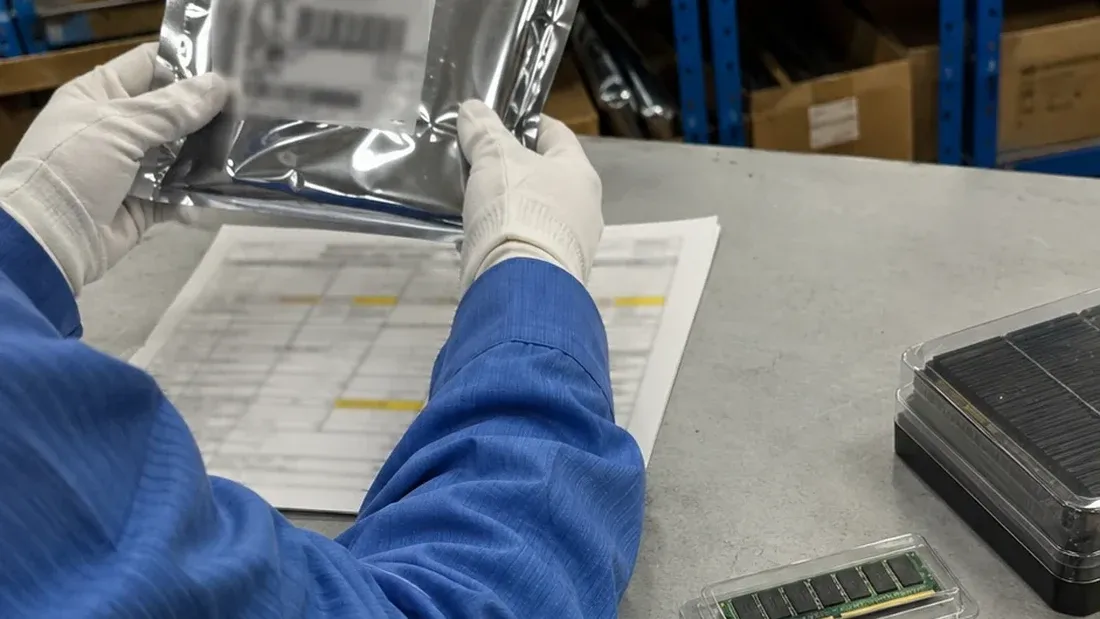
Image disclosure: the cover is an AI-generated representative supply-management scene. Its packages and paperwork do not establish a real supplier, available stock, a price or a delivery commitment.
What does HBM expansion affect first?
HBM belongs to stacked DRAM, not to nonvolatile NAND storage [1]. Micron's fiscal Q3 2026 prepared remarks discuss HBM growth alongside DRAM bit supply and packaging, including the pressure that successive HBM generations can place on non-HBM supply [2]. The first relationship is therefore a change in the DRAM product mix, not the direct use of NAND wafers to make HBM.
For the technology distinction, see what HBM, DRAM and NAND do in an AI device. Keeping that distinction clear prevents a market headline from becoming an incorrect component specification.
How can NAND still be affected indirectly?
Three paths deserve attention:
- A supplier changes capital allocation, cleanroom use or new equipment investment between DRAM, NAND and packaging.
- AI servers need SSDs for datasets, checkpoints, vectors or context data in addition to working memory.
- Supply pressure changes allocation, contractual terms or customer ordering behavior.
Micron's Q3 remarks describe some industry suppliers redirecting cleanroom space from NAND to DRAM and identify growing SSD opportunities in AI data centers [2]. This is one supplier's dated market assessment, with forward-looking elements. It is not a universal finding for every manufacturer, region or NAND product.
The IEA identifies AI as an important driver of growing data-center electricity demand [3]. This establishes a macroeconomic context for infrastructure expansion. It cannot be converted into Kalstor sales, a shortage of a particular NAND die or next month's price. No such conversion is used here.
Why are NAND markets not interchangeable?
Enterprise SSDs, client SSDs, microSD, eMMC and UFS can differ in NAND generation, density, packaging, controller, firmware and qualification route. Even when they use related NAND technology, the finished products cannot be freely substituted. Industrial projects add temperature, lifecycle, controlled-BOM and requalification constraints.
“The NAND market is tight” is therefore a background signal, not a purchasing specification. Actionable information identifies the part, capacity, NAND/controller configuration, firmware, available quantity, offer date, lead time, MOQ, quote expiry and change conditions.
Which signals should a buyer monitor?
- Formal lead-time updates from the manufacturer or an accountable supply channel.
- Allocation limits, discontinuation or revised delivery quantities for the same part.
- Shortening quotation validity.
- Whether one commercial model permits changes in NAND, controller or firmware.
- Whether sample and production configurations can be linked.
- Complete PCN, EOL and substitute-part notices.
- Clear MOQ, material-reservation conditions and delivery windows.
Compare like-for-like offers. A lower price for the same capacity may reflect a different configuration, warranty or delivery basis rather than a fall in the price of the qualified product.
How should quotation and fixed-BOM terms be defined?
A quotation should be dated and tied to capacity, interface, performance, temperature, configuration, quantity, packaging, destination and validity. Where a fixed BOM is required, specify the controlled level in writing: the finished-product number only, or also the controller, NAND, firmware, PCB/package and manufacturing route.
More restrictive control can affect MOQ, lead time and the supplier's ability to commit to price. Agree which changes require notification, additional samples or renewed approval. “Fixed BOM” without an agreed scope is not a substitute for these terms. Our fixed-BOM guide discusses the configuration side of this decision.
When should a second source be prepared?
Start while the primary supplier can still deliver, not only after supply stops. Triggers may include lead times beyond the project's tolerance, EOL or PCN notices, excessive concentration in a critical material, price changes beyond budget, or a customer's continuity requirement.
The alternative still needs host compatibility, performance, temperature, endurance, power-interruption behavior and production-configuration validation. The quantity printed on the label does not remove that work.
How can Kalstor support the purchasing decision?
Provide the exact model or host requirement, capacity, temperature, monthly quantity and purchasing period through our project inquiry form. Kalstor can organize a candidate supply scope, quotation-validity terms and second-source review items. Material availability and the proposed configuration must be confirmed before a commitment is made.
We do not turn market pressure into an in-stock claim, or assume a fixed NAND configuration and long-term price before the source is confirmed. Manufacturer commentary and IEA projections remain background evidence, not Kalstor stock proof or a guaranteed purchasing outcome.
FAQ
If HBM prices rise, must microSD prices rise too?
Can a second source replace the first if capacity is identical?
References
We publish measured usable capacity and define trial-batch verification against the quoted product and agreed test scope.