
Managing Traceability for Rotating MicroSD Cards in Field Recorders
- Assign distinct operational inventory IDs to cards and host units rather than assuming USB card readers can read low-level Card Identification (CID) registers.
- Document wall-clock reference offsets alongside internal recorder timestamps during every field insertion and removal.
- Implement a structured handoff ledger and maintain read-only archive copies before returning microSD media to field rotation.
Deploying multiple field recorders with interchangeable microSD cards introduces significant operational tracking challenges. When cards move rapidly between field units, offload stations, and maintenance benches, missing handoff records make it harder to locate a recording and explain gaps. A ledger makes each move auditable; it does not establish the correctness of the files.
Operational IDs vs. Hardware Identifiers
While SD standards define a Card Identification (CID) register containing manufacturing details, access to that register through a given USB reader or operating system must be verified. Do not make CID capture a mandatory field unless the chosen reader and software expose it.
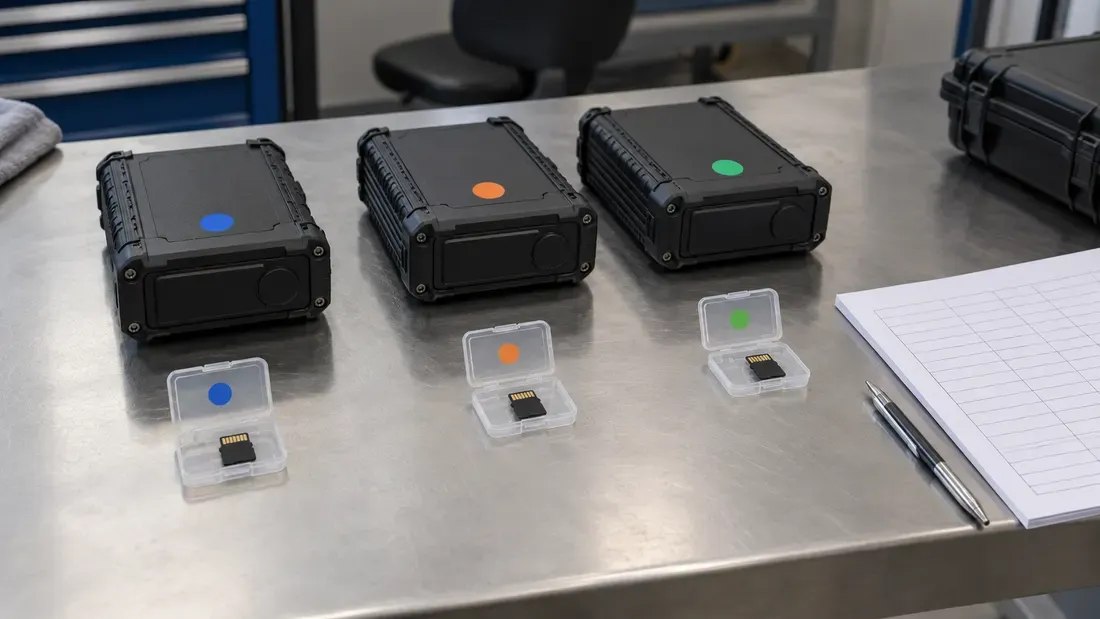
Assign an operational inventory ID to each card and recorder, and check that the marking survives the actual handling conditions.
Timestamp Tracking and Clock Drift
Some field recorders may lose synchronization or use a different time zone. Distinguishing between internal recording timestamps and actual wall-clock time is critical:
- Reference Wall-Clock Time: Time and source of a trusted reference clock at media handling.
- Recorder System Time: The time displayed or logged internally by the host recorder firmware upon card insertion and ejection.
Recording both values permits an offset estimate at that checkpoint; it does not correct an unmeasured drift throughout the recording.
Field Handoff and Verification Ledger
Field operators and data technicians should maintain a synchronized ledger across all shifts and media swaps:
| Card ID | Recorder ID | Action and handling time | Device clock and time zone | Operator | Export location and verification |
|---|---|---|---|---|---|
| Assigned ID | Assigned ID | Insert, remove or ingest; reference time/source | Displayed time and zone, if available | Recorded name/ID | File count, transfer status and optional file hash |
Post-Ingest Handling and Rotation
This process manages operational data integrity and does not constitute a certified legal-forensic chain of custody. To maintain media reliability throughout rotation cycles:
- Verify Integrity: Verify the copied file set against the source using the chosen workflow; a SHA-256 hash of a file can document that particular file, but does not prove no recording was omitted.
- Preserve Master Copies: Preserve the original card or an approved verified copy according to the retention policy before authorizing reuse.
- Format in Target Devices: If the recorder manual requires formatting for reuse, do it only after release for reuse and record that action. Do not assume one format rule applies to every recorder.
If your organization is standardizing media handling workflows across large fleets of field recording devices, explore hardware configurations through our quote request page.
We publish measured usable capacity and define trial-batch verification against the quoted product and agreed test scope.