
Robots and AGVs: choose eMMC or industrial SSD from the workload
- Start with the board interface and data flow, not capacity or an industrial label.
- Validate mounting, board strain, temperature and power recovery in the complete device.
- Tie sample approval to configuration, lot identity and commercial release conditions.
eMMC is a compact candidate for fixed boot software and controlled logging when the board supports it. An industrial SSD is a candidate for larger models, sensor buffers, images and long recording histories when SATA or PCIe/NVMe, power and cooling are available. Choose from the system data flow and board design, not the industrial label alone.
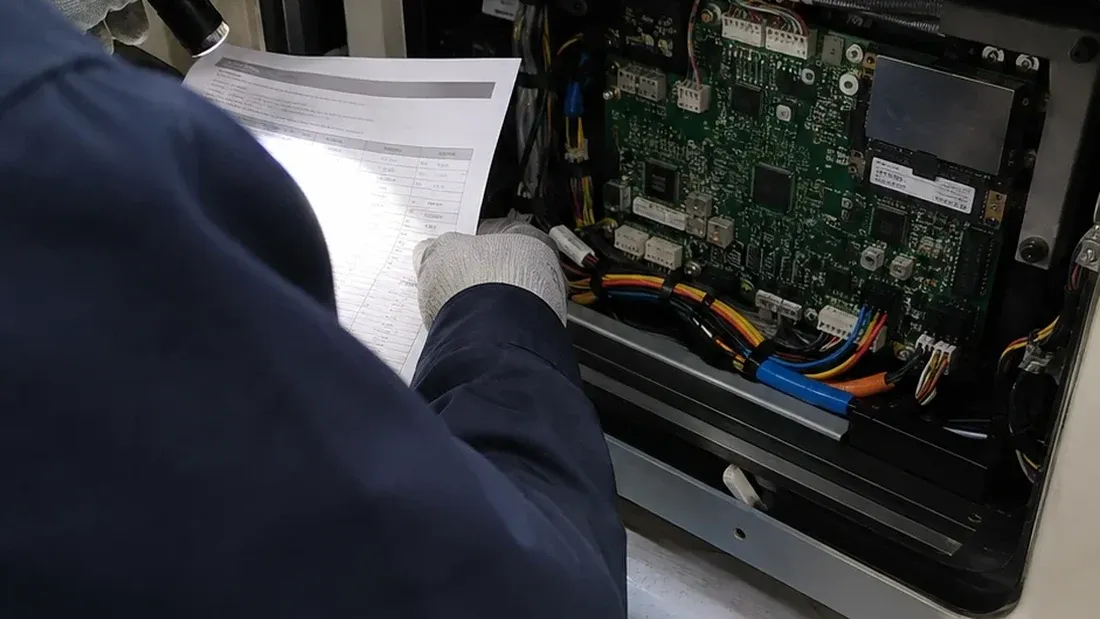
Image disclosure: this is an AI-generated representative maintenance scene, not an operating procedure or a verified AGV controller. The image cannot establish module identity, compliant fastening or whether power is disconnected.
Which storage tasks exist inside a robot?
Separate the operating-system image, maps, models, navigation configuration, task queue, sensor buffers, running logs, fault snapshots and OTA packages. Boot and model loading are read-heavy; logs and buffers may write continuously; fault capture can create short bursts. Updates need temporary capacity and a recovery path.
For each task, define retention and what losing it would mean. A diagnostic log can have a different acceptable loss window from navigation configuration. Storage approval should not silently become approval of a safety function.
When is eMMC suitable?
eMMC integrates NAND and its controller in a soldered BGA package. Micron describes it as JEDEC-defined managed NAND with internal media management and ECC [1]. It can reduce removable connections, but is less convenient to replace in the field. Confirm SoC boot support, interface mode, package and routing during board design.
Soldering does not eliminate mechanical risk. Board flex and solder-joint strain still depend on mounting and the actual environment. Confirm the precise part, not just a capacity and the word eMMC.
When is an SSD suitable?
SATA or NVMe SSDs are candidates for higher-capacity models, containers, databases, multi-sensor data and longer log retention. The Jetson AGX Orin Developer Kit illustrates platform-specific eMMC and optional storage paths [2]; it is not proof that every robot supports NVMe.
Compare sustained behavior under the intended workload, including cache exhaustion, simultaneous reads and writes, near-full operation and available thermal headroom. A high short benchmark result does not define hours of logging.
Why review interfaces and mechanics before capacity?
An M.2 socket may expose only some protocols. Keying, module length and physical fit do not establish SATA or PCIe compatibility. Check the schematic, BIOS/UEFI or bootloader, supported protocol, lane count, boot path, height clearance and retention hardware. A 2.5-inch SATA drive also needs data and power connections and mounting space.
Record the cable and carrier configuration used for qualification. Substituting a cable, standoff or carrier can alter the result even when the storage SKU stays unchanged.
How should vibration, temperature and power interruption be assessed?
Test with the intended mounting, harness and board. Look for transient disconnections, resets and I/O errors; absence of spinning platters is not whole-system vibration qualification. Include eMMC solder joints and board strain in the mechanical review.
Distinguish ambient, enclosure, controller and NAND temperatures where measurement is available. Record throttling and workload timing. Use customer-defined environmental conditions rather than an invented universal industrial threshold.
Set controlled power interruptions at observable read, write, log-sync and update stages. Claim coverage of internal garbage collection only with reliable telemetry or supplier tools. Successful reboot does not prove file integrity, and an error does not automatically establish storage as the root cause. Use dedicated samples and backed-up data.
How much OTA and rollback space is needed?
An update may retain old and new software, a differential package, snapshots and recovery data. Android Virtual A/B illustrates temporary storage use during updates [3]. Other Linux or real-time systems need a budget based on their own partitions, container layers and model versions.
Check the worst simultaneous occupancy while logs continue. A capacity reserve must follow the actual update design; there is no percentage that qualifies every robot.
What connects samples to production?
Record the exact eMMC or SSD, agreed controller/NAND/firmware identity, PCB or package revision, capacity, temperature grade and lot. Cover power-on and repeated boot, model reads, sustained logging, near-full use, controlled interruption, vibration and temperature in the agreed plan.
Technical acceptance is separate from price, MOQ, lead time, payment, PCN, warranty and RMA approval. Production release also requires the supplied lot to match the approved baseline. See the AI storage hierarchy before comparing device categories.
Send Kalstor the board interface, operating system, model and log workload, environment, lifecycle and quantity. These details support candidate selection and the link between samples, records and production identity; project-specific availability and services require confirmation.
FAQ
Is an industrial SSD necessarily more vibration-resistant than eMMC?
Does soldered eMMC eliminate lot control?
References
We publish measured usable capacity and define trial-batch verification against the quoted product and agreed test scope.