
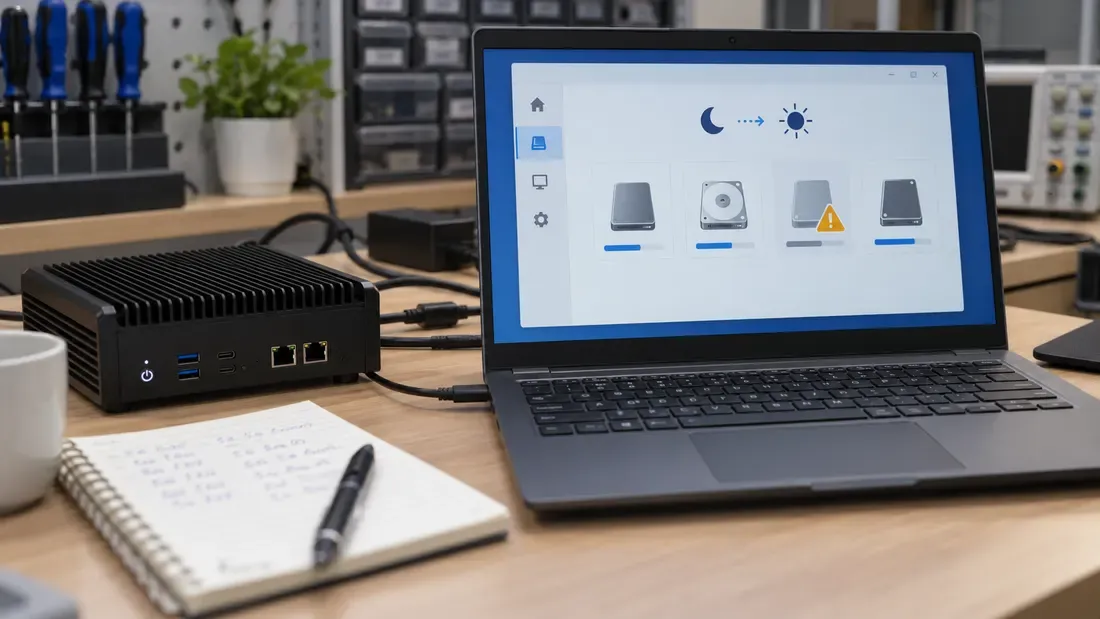
NVMe SSD Disappears After Sleep: Separate APST, PCIe and Host Resume Faults
- A failed mount or application read does not by itself mean the NVMe SSD disappeared from PCIe.
- NVMe APST, PCIe ASPM and platform sleep or runtime D3 are distinct mechanisms; the supported path depends on the host.
- Compare repeatable state transitions and preserve logs before changing a power policy or replacing a drive.
An SSD that reads normally after a cold boot but fails after idle or system sleep needs a transition test, not an immediate drive replacement. First locate the failure: did the PCIe endpoint vanish, did the NVMe controller or namespace become unavailable, did the operating system fail to mount the volume, or did only the application time out? These are different incidents with different evidence.
Which power transition failed?
NVM Express describes autonomous power state transition (APST) as an NVMe mechanism for moving among supported controller power states. PCIe active state power management (ASPM) concerns the PCIe link. Host platform sleep and runtime device power states add further transitions. Their implementation and availability depend on the board, firmware, operating system and driver. Do not call every wake failure an APST defect.
Microsoft's NVMe power management guidance describes specific Windows and Modern Standby behavior, including a qualification constraint for APST-enabled devices in that stack. It is not a universal rule for every Windows installation or Linux host.
Build a transition and observation matrix
Keep the same host, SSD part number and firmware, OS build, driver and power policy while comparing states. Record timestamps and any available logs before and after each transition. If the device is no longer accessible, preserve the host log and configuration; a fresh drive log may be impossible to read.
| Test path | Trigger | Evidence to capture |
|---|---|---|
| Cold boot | Power-on to first application transaction | PCIe endpoint, controller identity, namespace, mount and transaction result |
| Warm restart | OS reboot without changing hardware | Same checkpoints, plus boot and driver errors |
| Awake idle | Documented idle interval, then first representative I/O | Last successful I/O, first failed request, endpoint/controller state and host errors |
| System sleep and resume | Only a sleep mode supported by this host | Sleep mode, resume timestamp, endpoint enumeration, namespace and mount state |
| Repeated cycle | Repeat the failing supported path | Failure count, cycle number and whether behavior is reproducible |
Classify the first missing checkpoint. If the PCIe endpoint is present but the filesystem does not mount, investigate the block, partition and filesystem layers before concluding that the link or SSD power state failed. If the endpoint disappears, collect upstream port and platform power events as well as drive identity. An application timeout with a mounted volume still needs an application and I/O trace.
Change one controlled condition at a time
With the system owner, compare a known-good drive or host under the same supported transition. A controlled change to a host power policy can help isolate a path, but record the original setting and restore it after the test. Do not disable APST or ASPM across a fleet as a generic cure. Changes to firmware or drivers need their own qualification; see the NVMe firmware rollout guide.
For a candidate replacement, send the exact host/drive combination, failing transition and checkpoint matrix with a quote request. That gives engineering and purchasing a reproducible compatibility question instead of the vague report “NVMe drops after sleep.”
References
We publish measured usable capacity and define trial-batch verification against the quoted product and agreed test scope.