
Can you buy a microSD card missing from the camera compatibility list?
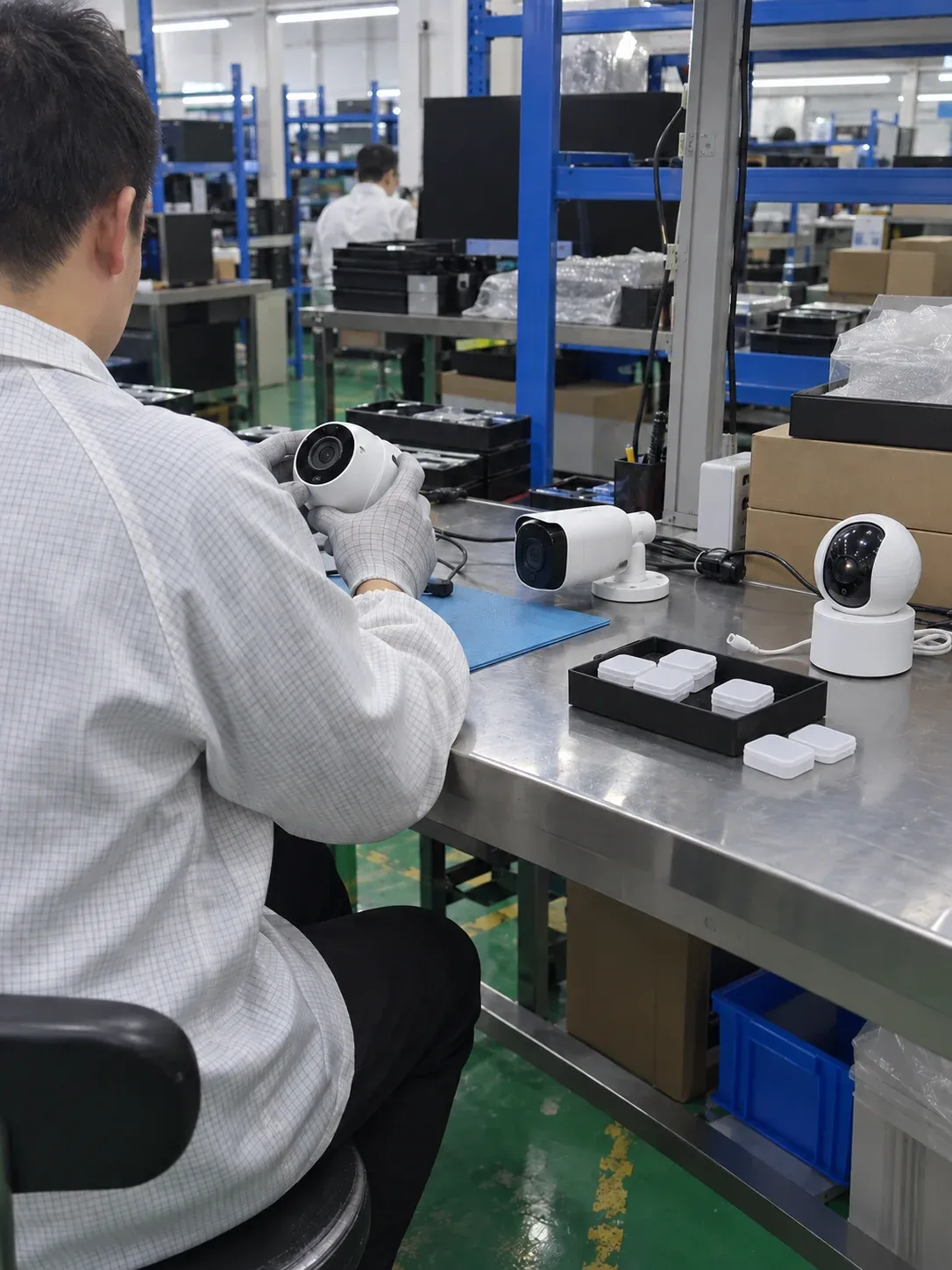
AI-generated scene illustration; not a factory photograph or evidence of testing.
Absence from a camera compatibility list is not proof of incompatibility, but it is not approval for a volume order either. Check the manufacturer's policy for unlisted products and validate the exact card, capacity, camera hardware and firmware. Not listed and tested unsuccessfully are different states.
A camera brand name is not a compatibility specification. Two models accepting microSD may differ in capacity limits, formatting, recording modes and firmware handling.
Read the device manufacturer's evidence
Start with the manual, hardware-specific support page and list revision date. Separate recommended cards, tested cards, minimum requirements and explicit exclusions. TP-Link's Tapo/Kasa guidance illustrates why card and device scope must be read together; it does not certify Kalstor cards.
Record what was actually tested
The following is a suggested procurement record, not a brand's test result.
| Field | Record |
|---|---|
| Camera identity | Exact model, hardware revision and firmware |
| Card identity | Full part number, capacity, sample and lot identifier |
| Conditions | Recording mode, resolution such as 4K or 8K, frame rate, codec, bitrate, channels and formatting |
| Basic functions | Recognition, in-device formatting, recording and playback |
| Operation | Circular overwrite, restart, temperature and exceptions |
| Conclusion | Pass, conditional pass, fail or not tested |
A conditional pass must state the restriction, such as one firmware revision or recording mode. A blank field means not tested, not an assumed pass.
Why a computer test is not a camera test
Writing known test data across an agreed range, completing persistence and checking readback can test consistency over that range. Viewing reported capacity or reading a few existing files cannot establish full-card capacity. Record covered bytes, tool and reader, and exclude host-cache interference. Destructive write checks require an authorized card with no important data; see the capacity verification guide.
A reader benchmark reflects that host configuration. The camera has its own cache, rotation, index and power handling. A computer pass does not show that old video will be overwritten correctly after the card fills.
Run the intended scene through repeated file rotation and overwrite. Inspect segment continuity and playback of important clips. Duration and sample count should follow project risk and acceptance criteria, not a universal invented number of hours.
Describe compatibility with limits
Do not write compatible with every surveillance camera. State sample identity, device identity, conditions, results and untested items.
If 4K, 8K or higher resolution is required, record it alongside frame rate, codec, bitrate and concurrent channels. Passing one resolution does not approve higher resolution or changed settings. Resolution alone cannot replace the actual write workload; these fields are requirements to validate, not a Kalstor promise of universal 4K or 8K support.
Changes to card capacity, configuration or host firmware require a review of whether the evidence still applies. Decide retesting from the change and its risk, not from an unchanged external appearance.
Submit a model list to Kalstor
For multiple cameras, send models and firmware, capacity, recording mode, resolution and bitrate, quantity and manufacturer requirements. Highlight 4K, 8K or higher-resolution use. Request candidate recording media and review high-endurance microSD options, then agree sample and validation responsibilities.
Use the recorder-card selection guide for the broader buying process and the retention calculator for capacity. A proposed sample is not a manufacturer endorsement or a completed qualification.
FAQ
Can a pass on another camera from the same brand be reused?
Does absence from a list mean a card is counterfeit?
References
We publish measured usable capacity and define trial-batch verification against the quoted product and agreed test scope.