
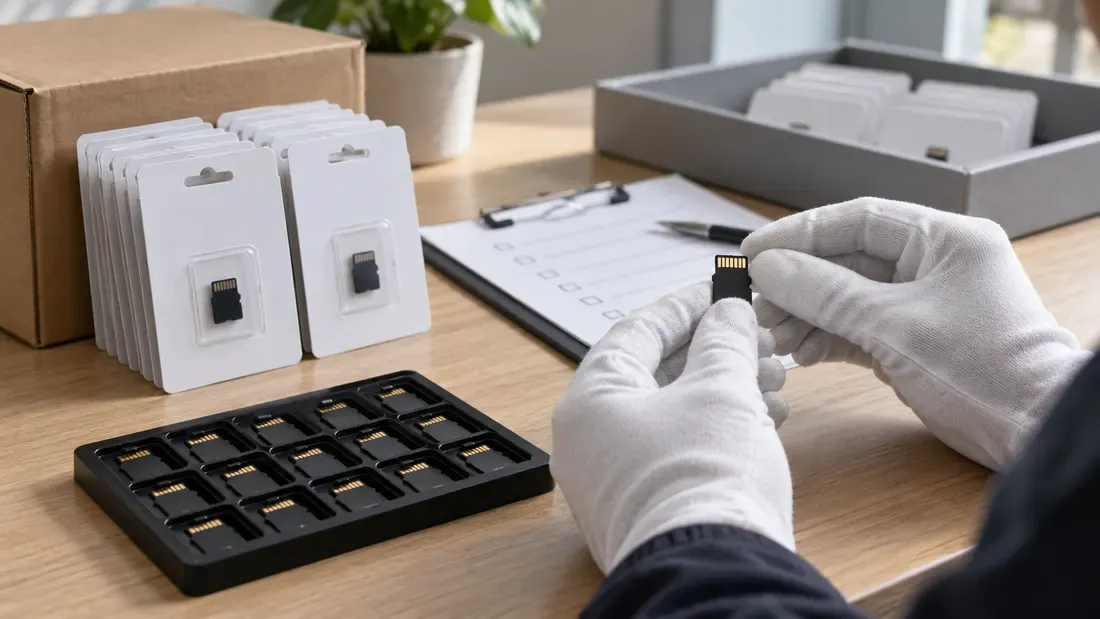
Private-Label microSD: A Buyer Checklist Before Lot Release
- A digital artwork proof approves appearance, not card performance or a production lot.
- Tie each printed capacity, speed and compatibility claim to the exact configuration and supporting evidence.
- Before dispatch, reconcile the card, package, barcode data and lot record against one approved purchase revision.
Release a private-label microSD lot only after the physical card, package, identifiers and agreed test record point to the same approved product. A signed artwork PDF can confirm layout and wording, but it cannot show that a class mark is supported by the selected card, that a printed barcode resolves to the intended trade item, or that the shipped lot matches the sample. The buyer should make those checks explicit before authorizing dispatch.
This is a buyer's release checklist. The actual manufacturing, inspection and approval responsibilities must be agreed for each project; a generic workflow cannot establish what a particular supplier has performed.
Match printed claims to evidence
Start with the current purchase specification and approved technical configuration. Check every claim on the card, retail package, insert and carton. A printed statement should have an identified owner, evidence and an applicable product revision.
| Visible statement | What to confirm before approval |
|---|---|
| Capacity and product name | The selected card configuration, label and order agree; the agreed capacity or functional check is tied to the sample or lot. |
| SD family and speed-class marks | The selected product supports each declared mark under the relevant SD conditions, and the party using SD logos or trademarks has checked applicable rights. |
| Read or write speed claim | The number is identified as minimum, typical or maximum, read or write, with a test setup appropriate to the exact card. |
| Endurance, temperature or device compatibility | The claim has a stated workload, environmental or named-host boundary and evidence for the selected configuration. |
| Warranty or other commercial statement | The printed wording matches the written policy for the intended market and channel. |
The SD Association's speed-class definitions concern specified write-performance classes. An “up to” read-speed result does not substantiate a U3 or V30 write-class mark. The SD Association also describes separate agreements and rights for its standards, logos and trademarks. Confirm the planned marks with the relevant licence or rights holder; this checklist does not decide licensing status for a specific company.
Do not infer the internal controller, NAND or firmware from the card's outward appearance. If a project needs those items controlled, put the agreed identity or change-notification boundary into the purchase specification and sample record. Our specification-control guide explains why a catalog name, quote, approved sample and later lot are different evidence layers.
Sign off the physical card and package together
Use one release record for the proposed shipment. Record the approved revision, the sample used as reference, the actual lot and any accepted deviation. Mark an item “not applicable” only when it truly is outside the order.
| Check | Buyer record to compare with the shipment |
|---|---|
| Card face | Capacity, model and class marks, print position and legibility versus approved physical proof. |
| Package and accessories | Wording, language, card count, adapter or reader if ordered, and carton contents versus approved package specification. |
| Barcode and product data | Scanned code and human-readable digits versus the intended trade item and package level; identify who supplied and approved the data. |
| Technical configuration | Agreed product or revision identity, approved sample and change notices versus the proposed lot. |
| Lot evidence | Lot identifier, agreed sampling or test scope, result and unresolved deviations. |
| Preloaded content, if ordered | Approved image or file manifest, version and verification result; see the content-loading guide. |
| Release decision | Named approver, date, accepted exceptions and exact purchase/order revision authorized to ship. |
GS1 says the brand owner normally allocates the GTIN, while recognizing exceptions. Determine who owns the numbering and approved data for this project before printing. A barcode that scans successfully can still identify the wrong product if the encoded number, human-readable text or packaging level is incorrect.
Reapprove the parts affected by a change
A revision to artwork, card configuration, packaging contents or identifier data can affect different approvals. State the changed field, old and new revision, affected lots and the evidence needed to accept it. A color or spelling correction may need a new artwork proof; a speed-class or capacity claim needs supporting product evidence as well as artwork review. A controller, NAND or firmware change within an agreed control boundary may require a new sample or host test. An accessory change affects the package and order even if the card is identical.
Under GS1's primary-brand rule, changing the primary brand shown on a trade item calls for a new GTIN, including applicable higher packaging levels. Do not assume every graphic edit has that effect; apply the relevant GS1 rule and market requirements to the actual change. A familiar retail name alone does not establish that the technical configuration, packaging revision or lot is the one the buyer approved.
Before release, compare the purchase order, approved proof, physical card, package data and lot evidence in one review. Send the target market, artwork, capacity/class requirements, accessories, expected quantities and required evidence through the OEM contact or quote request to define a project-specific approval scope. Price, availability and production timing depend on the confirmed configuration and order.
References
We publish measured usable capacity and define trial-batch verification against the quoted product and agreed test scope.