
Industrial vs consumer SSD: six procurement checks
- Confirm interface, protocol, installation and boot support first.
- Compare six model-level requirements rather than an industrial label.
- PLP, endurance and configuration control require specific evidence and conditions.
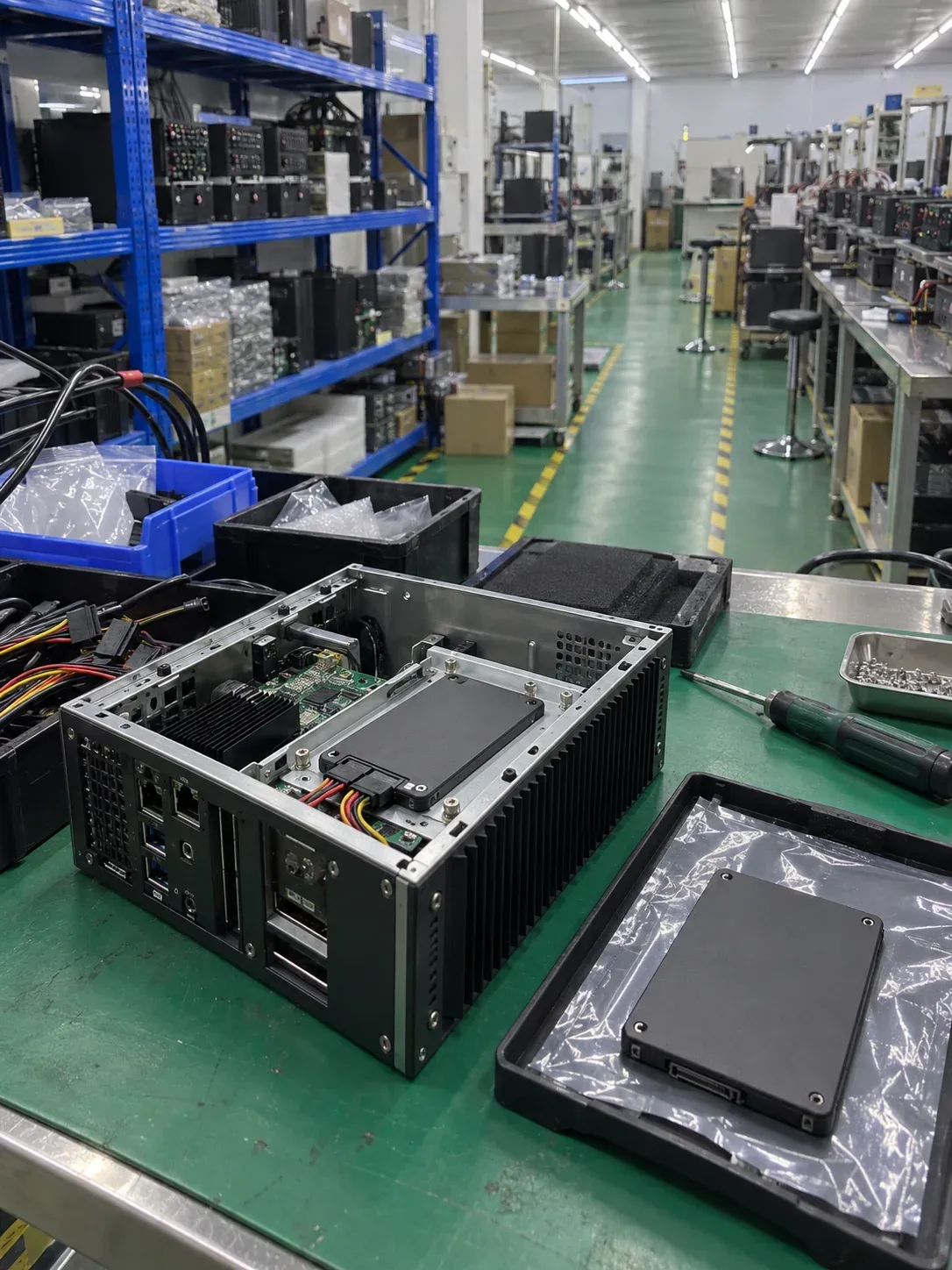
AI-generated scene illustration; not a factory photograph or evidence of testing.
Choose an industrial or consumer SSD by the exact model's suitability for the device, not its label. Confirm the motherboard interface and installation first, then compare workload, environment, power-loss behavior and supply requirements. Two 512GB drives are not interchangeable simply because their capacity matches.
Confirm the host before comparing speed
Obtain the motherboard or equipment manual and check protocol, dimensions, power, fixing points and boot support. M.2 describes a form factor and connection specification; a SATA-only socket does not become NVMe-compatible because a module fits. M.2 interface guidance.
For a drive specified as PCIe 4.0 x4 and NVMe 1.4, the first term identifies the PCIe generation and lane count; the second identifies the NVMe protocol revision. Check the host's actual PCIe connectivity, available lanes, firmware and operating-system support separately. A PCIe 4.0 x4 link requires appropriate support at both ends. However, a compatible Gen4 SSD can operate on a Gen3 platform at the negotiated lower link rate; Gen4 is not an absolute motherboard requirement for basic use. PCIe generation compatibility.
For an existing machine, the customer or maintenance provider must also confirm boot and application behavior. Kalstor supplies storage hardware, not system installation or recovery.
Six requirements for the purchasing comparison
| Requirement | Evidence for the exact model | Do not infer |
|---|---|---|
| Host fit | Interface, protocol, dimensions, power and boot support | Matching socket shape proves compatibility |
| Sustained performance | Workload, fill state, duration and latency | Burst speed predicts sustained behavior |
| Write endurance | Capacity-specific rating and conditions | NAND type alone establishes drive life |
| Environment | Complete-drive operating range and measurement definition | Ambient, case and controller temperature are identical |
| Power loss | Protected data scope and system recovery result | Every file is safe because the label says PLP |
| Continued supply | Part identity, configuration boundaries, change notice and lead time | A family name guarantees an unchanged configuration |
This is a comparison checklist, not a statement that every Kalstor product has these features. Industrial suppliers discuss environment and lifecycle, but the applicable capability must be documented for the selected item. Swissbit selection overview.
Read endurance and protection at model level
Continuous recording does not automatically require pSLC or MLC, nor does TLC automatically rule out a drive. Compare actual writes with the specified endurance, workload and temperature. Where TBW or DWPD is provided, retain its definition and warranty conditions; it is not a universal failure deadline. See TBW and DWPD and NAND configurations.
Likewise, power-loss protection may protect mapping information, acknowledged user data in flight, or a defined combination. Identify the implementation, hold-up behavior where applicable and test conditions rather than inferring complete protection from visible capacitors.
Wide-temperature ratings are model-specific. For automotive projects, AEC-Q100 applies to relevant integrated circuits; it does not by itself qualify an assembled SSD or complete vehicle system. Preserve the applicable component and system evidence. AEC qualification documents.
Configuration control is also contractual. Agree which controller, NAND and firmware properties are fixed, which changes require notice and when requalification is necessary. Request lifecycle or end-of-life information where the project needs it, without assuming that the word industrial guarantees years of unchanged supply.
When a client SSD can remain a candidate
A stable environment, light writing, protected system power and easy maintenance may permit a suitable client product. Unattended operation or costly downtime increases the value of documented environmental behavior, recovery and change management. Server duty is not automatically light duty: confirm its actual write, latency and integrity requirements.
There is no universal price threshold between acceptable and unacceptable. Compare what the price difference buys against the project's requirements. Proprietary features in a manufacturer's comparison are not evidence for another brand. ATP comparison.
Information to send with an SSD RFQ
Provide the motherboard or equipment model, current drive part number, interface and protocol, capacity, use case, typical and largest file sizes, write frequency, estimated daily writes, temperature, power-loss exposure, initial quantity and purchasing schedule. Distinguish log files, large video files and bursts rather than supplying only a daily average.
File size is not the size of each I/O request sent to the SSD. If measured, include block size, sequential or random access, concurrency and durability requirements; mark unavailable measurements as pending. The host may cache writes, so an application reporting completion does not alone establish persistent storage. Microsoft file-caching explanation.
If cache protection is required, specify whether the concern is data in the SSD's volatile cache, internal mapping information or data not yet submitted by the host. Drive-level PLP cannot protect data it has not received and does not guarantee complete application files. PLP scope.
Start with Kalstor industrial SSD options and submit the project requirements. Configuration, evidence and lead time require confirmation for the proposed hardware; software installation, imaging and recovery remain the customer's responsibility.
FAQ
Is an industrial SSD always slower than a consumer SSD?
Do capacitors prove complete power-loss protection?
References
We publish measured usable capacity and define trial-batch verification against the quoted product and agreed test scope.