
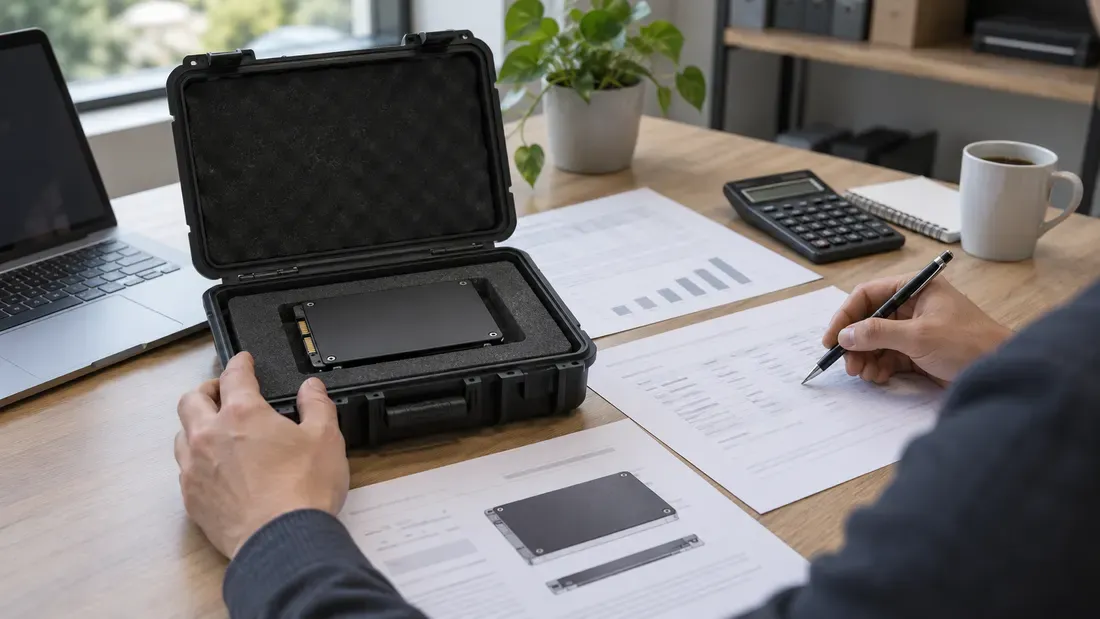
Compare Flash Storage Quotes by Project Cost, Not Unit Price Alone
- Compare candidates against the same host workload, quantity, time horizon and contractual terms.
- Keep one-time, per-unit and conditional field costs separate, with an owner and evidence for each input.
- Unknown failure frequency or downtime cost belongs in a sensitivity range, not a made-up total.
The lowest drive quote is not automatically the lowest-cost project, but neither is a dearer part automatically safer. Compare the cost of making each candidate work in the same device over the same planned service period. Record what is known, who owns each expense and which events are uncertain. A worksheet makes those assumptions visible to engineering, procurement and service teams.
Start with a consistent flash-storage RFQ. Both candidates need the same capacity, host interface, write workload, qualification conditions, delivery quantity and comparison period. Record the exact part and revision. Differences in warranty, product-change notice or delivery terms belong in the worksheet; they should not be silently treated as equal.
Build the cost record
| Cost line | Type | Owner and evidence to enter |
|---|---|---|
| Drive purchase and inbound logistics | Per unit | Procurement: written unit quote, quantity break, shipping and applicable duties. |
| Initial host qualification | One time per candidate/project | Engineering: planned samples, test hours and any external test fee. |
| Factory preparation and acceptance | Per unit or batch | Manufacturing: measured programming, verification, labeling and rejection time. |
| Spare stock and inventory holding | Time-dependent | Supply chain: planned spares, storage cost and obsolescence exposure. |
| Requalification after a part or firmware change | Conditional event | Engineering: change-notice terms and cost of the test plan actually required. |
| Field replacement and data restoration | Conditional event | Service: access, labor, travel, backup/recovery and return logistics, if relevant. |
| Interrupted operation | Conditional event | Business owner: affected process, likely duration and documented value of lost operation. |
The AWS business-case guidance treats interruption duration and support labor as inputs to a detailed case. It is a cost-category example from cloud work, not evidence of industrial flash failure rates, flash prices or downtime cost at your site. Use your own contracts, service logs and application owner to populate this table.
A product-change policy can alter the number of times a host must be requalified. Kingston describes controlled BOM and PCN procedures for its industrial SSD line. That describes Kingston's offering only. For either quote, ask what the actual supplier contract says about controller, NAND and firmware revisions, notification timing and approved alternates. Do not assume a missing statement means a change will occur or assign a cost before estimating the event.
Calculate without hiding uncertainty
For a defined project horizon, add the one-time amounts, plus planned units × verified per-unit costs, plus the cost of conditional events only under an explicit scenario. For a possible field failure, the scenario needs an event count, cost per event and an owner for both estimates. Mark any unavailable frequency or repair time unknown. Compare a range of plausible inputs supplied by the responsible team rather than pretending one expected total is measured.
Avoid double counting. If a warranty covers replacement media, check whether logistics, on-site labor and data are included before entering them elsewhere. If factory verification is in the supplier price, remove it from a separate factory line. A longer warranty is not a measured reduction in failures, and an MTBF headline is not a field-return forecast. Candidates may prove equivalent; the worksheet should allow that result.
Before selecting a part, show three things side by side: a price and known-cost subtotal, the unresolved event inputs, and the qualification or contract evidence needed to close them. Send the same assumptions with the quote request so each supplier responds to the same engineering and commercial question.
References
We publish measured usable capacity and define trial-batch verification against the quoted product and agreed test scope.