
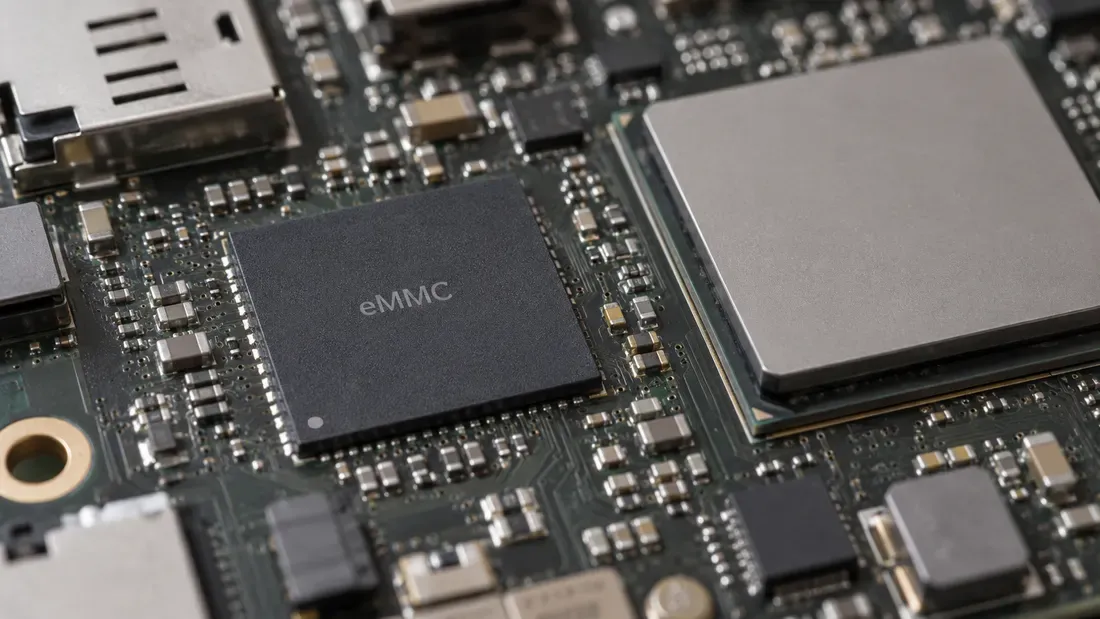
eMMC HS200 and HS400 Qualification: Host Controller, Board, and BSP Alignment
- An eMMC reporting HS200 or HS400 support in EXT_CSD does not prove the SoC, board and BSP will run that mode.
- Host peripherals vary significantly; for example, STMicroelectronics documentation highlights that the STM32MP15 line does not support HS200 mode.
- HS400 signaling does not automatically guarantee superior application-level throughput, which remains gated by access patterns, controller overhead, and flash latency.
An eMMC device may advertise HS200 or HS400 capability while the assembled board runs another mode. The card's capability is only one input: host controller, power and board design, BSP configuration and actual runtime negotiation must also align. A higher interface mode alone does not guarantee a faster application.
Trace the capability chain
| Layer | Evidence to request | What it can establish |
|---|---|---|
| Exact eMMC part | Data sheet and reported EXT_CSD capability for its revision | Which modes this device supports |
| SoC host controller | SoC reference manual and errata | Which modes and I/O conditions the host supports |
| Assembled board | Schematic, power rails, routing review and assembly revision | Whether the required electrical path is implemented |
| BSP/driver | Device-tree or platform settings, driver and boot logs | Which modes software enables and any tuning/fallback messages |
| Runtime | Negotiated mode, error counters and representative workload | Which mode operated stably in this system |
The STMicroelectronics device-tree documentation gives a useful platform-specific counterexample: its STM32MP15x line has a stated HS200 limitation. That fact must not be transferred to another SoC. A Micron part-selection tool lists interface capability by candidate part; it does not certify a buyer's board.
Diagnose a fallback
Freeze the board, boot software and exact eMMC revision. Compare expected and observed modes and save initialization/tuning logs. If a mode is unavailable, check host documentation and BSP first. If an enabled mode is unstable, use the board's approved signal and power validation plan with the responsible hardware engineer; do not force voltages or timing from a generic article. Rerun the actual boot and I/O workload after any controlled change.
When requesting a substitute part, send the SoC, board/BSP revisions, operating mode and failure log with the quote request.
References
We publish measured usable capacity and define trial-batch verification against the quoted product and agreed test scope.